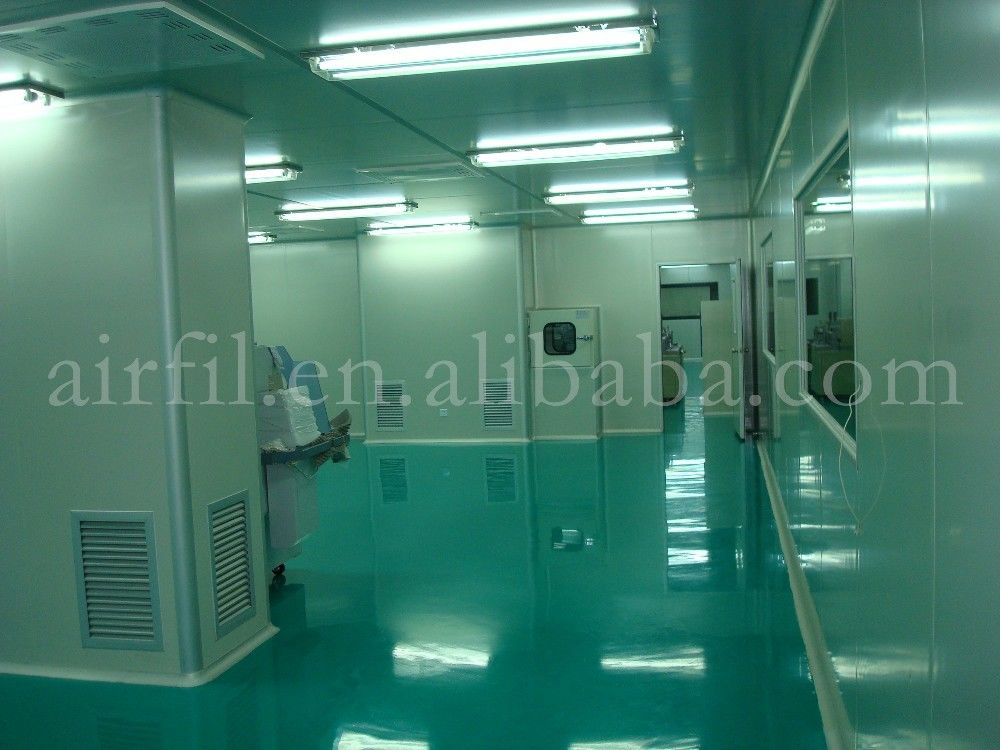
Product Details
Place of Origin: China
Brand Name: ZJNF
Payment & Shipping Terms
Minimum Order Quantity: 1
Price: negotiate
Packaging Details: plywood/wooden package
Delivery Time: 18days
Payment Terms: tt lc PayPal credit card
Application: |
100 Lab / Laboratory Clean Room, Pharmaceutical, Chemical Lab, Electronic Plant, Hospital |
Air Exchange Rate: |
100,000-grade 10-15 Times/hour |
Type: |
Clean Room Booth, Modular Designs, Cleanroom |
Intelligent Environmental Control: |
10-inch Touchscreen Integrated Control System Provides Real-time Monitoring Of Temperature, Humidity, Differential Pressure, Cleanliness, Etc., With Remote Control Via Mobile/PC. |
Body Material: |
Cold-roll Steel / Stainless Steel |
Product Category: |
Modular Clean Room |
Modular Structural Design: |
Main Framework, Envelope Systems, And Purification Equipment (FFUs/air Showers, Etc.) Are Pre-fabricated As Standardized Modules, Enabling Flexible Assembly And Expansion. |
New Energy/R&D: |
Rapid-deployment Solutions For EV Battery Workshops And University Labs, Ideal For Small-scale (<500 M²), High-flexibility Needs. |
Application: |
100 Lab / Laboratory Clean Room, Pharmaceutical, Chemical Lab, Electronic Plant, Hospital |
Air Exchange Rate: |
100,000-grade 10-15 Times/hour |
Type: |
Clean Room Booth, Modular Designs, Cleanroom |
Intelligent Environmental Control: |
10-inch Touchscreen Integrated Control System Provides Real-time Monitoring Of Temperature, Humidity, Differential Pressure, Cleanliness, Etc., With Remote Control Via Mobile/PC. |
Body Material: |
Cold-roll Steel / Stainless Steel |
Product Category: |
Modular Clean Room |
Modular Structural Design: |
Main Framework, Envelope Systems, And Purification Equipment (FFUs/air Showers, Etc.) Are Pre-fabricated As Standardized Modules, Enabling Flexible Assembly And Expansion. |
New Energy/R&D: |
Rapid-deployment Solutions For EV Battery Workshops And University Labs, Ideal For Small-scale (<500 M²), High-flexibility Needs. |
Selecting the cleanroom classification primarily involves matching the sensitivity of the production process to particles and microorganisms. Here's a clear decision framework for you:
1. Clarify your core needs
First ask yourself: What does your product fear the most? Is it micron-level dust or invisible microorganisms? This determines whether you should follow the ISO standard (for particle control) or the GMP standard (which addresses both microorganisms and particles). For example, chip manufacturing fears dust, while biopharmaceuticals fear microorganisms.
2. Refer to typical industry classifications
Different industries have established conventions, which serve as a great starting point:
ISO Class 1-3 (Class 100/1,000): Semiconductor lithography and production of high-end medical device implants, with zero tolerance for sub-micron particles.
ISO Class 5 (10,000): Used for sterile pharmaceutical filling and precision optical component manufacturing, requiring strict microbial control.
ISO Class 7-8 (Class 100,000): Suitable for food packaging and general medical device assembly, meeting basic dust control requirements.
ISO Class 9 (Class 100,000): Suitable for raw material storage and simple assembly, with relatively low cleanliness requirements.
3. Consider three practical principles
Precision Matching: Avoid blindly pursuing high cleanliness levels. For instance, a food raw material warehouse only requires a Class 100,000 standard, while a chip lithography area must meet a Class 100 standard.
Reserve for Upgrades: If future process improvements are possible, design with reserved space and piping interfaces to reduce later renovation costs.
Regional Differentiation: Divide the same workshop into different-grade zones, such as a "Class 100,000 raw material area + Class 10,000 packaging area," which meets requirements while reducing costs.
4. Focus on key parameters
In addition to the rank, it also depends on:
Air change rate: For Class 100 (ISO Class 4), it should be ≥200 times/hour; for Class 100,000 (ISO Class 7), approximately 15-20 times/hour.
Temperature and Humidity Control: Typically maintained at 18-24°C and 45-65% humidity.
Pressure differential design: Prevent contamination from low-cleanliness areas to high-cleanliness areas.
5. Seek Professional Support
The final proposal recommends please send inquiry to us,we will make custom design for you asap.